
Marshall County Tentative Release Dates
Mississippi's public MDOC label is Tentative Release Date. For a Marshall County state sentence, it is a calculated milestone, not a guaranteed pickup day. MDOC may also calculate parole eligibility, earned release supervision, maximum release, or discharge dates. Each Marshall County date describes a different point in the sentence. The public detail page shows only part of the computation, so the full time sheet may be needed when dates appear to conflict.
A person awaiting trial in Marshall County Jail is different. Pretrial custody has no fixed sentence end. Release can follow a bond order, recognizance, dismissal, transfer, or other court action. Even a court order does not prove the exact hour staff completed the departure. Ask the sheriff for the jail-docket release entry and the county court for the order. A person serving a short county sentence may have a locally computed date, but no verified Marshall County local good-time or weekend-release policy was found.
A Marshall County transfer is not a release. Someone can leave Marshall County Correctional Facility for another MDOC institution while remaining incarcerated. The public location and location-change date help show that distinction. The same rule applies when Marshall County Jail sends someone to MDOC, another county, the U.S. Marshals Service, or ICE.
Find Marshall County Projected Release Dates
Begin with the last known custodian. Marshall County Jail and Marshall County Correctional Facility share a county name, but they belong to separate systems. The sheriff keeps the county jail docket. MDOC operates the state prison and computes state-sentence dates. Searching the wrong system can produce no result or a result that belongs to a different stage of custody.
- Identify whether the person is a county detainee, county-sentence prisoner, or MDOC prisoner. Use the booking record, judgment, or transfer destination if the status is unclear.
- For MDOC custody, open the official offender search and use the MDOC ID when available. An exact-name search is the next best route.
- Compare the MDOC number and date of birth before opening the detail. Read the current location, location-change date, sentence blocks, and the exact Tentative Release Date label.
- For Marshall County Jail, call the sheriff at 662-252-1311 and ask for the jail docket, sentence computation if one exists, and the actual release entry.
- Obtain the certified judgment or commitment order from the Marshall County Circuit Clerk when that court holds the case. Check sentence length, concurrent or consecutive terms, and any stated county-jail credit.
- If a state computation appears wrong, ask MDOC Records for the time sheet and a written answer tied to the MDOC number and case.
The official MDOC Inmate Search is the statewide starting screen for a state sentence. Its current form can be checked before using the captured interface.
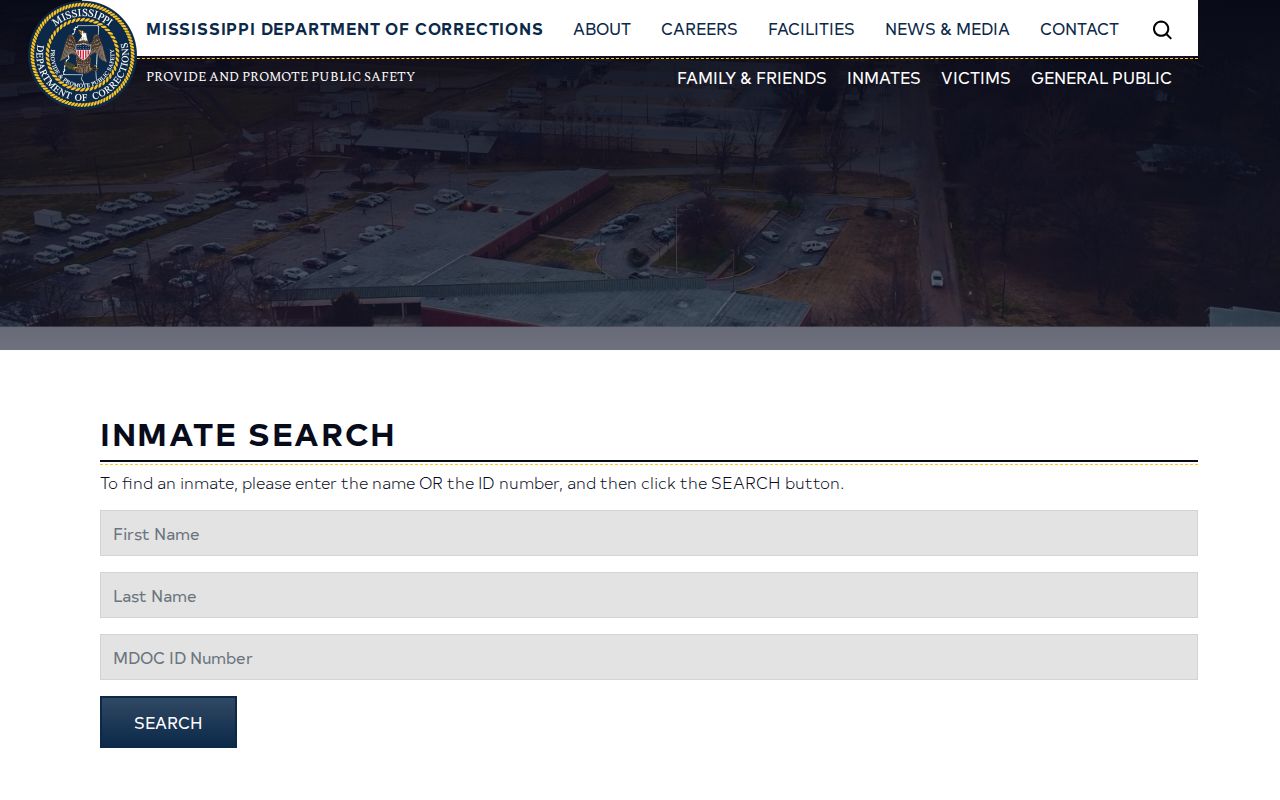
The image shows the official search entry point. It does not cover an ordinary Marshall County Jail booking that never became an MDOC commitment.
The full Marshall County release-record and custody search can help identify the last custodian before any date is treated as controlling.
Marshall County MDOC Search Fields
Marshall County MDOC search results help distinguish people with similar names. The result columns include ID Number, Last Name, First Name, Location, Term, Offense, and View. Opening the detail adds the photograph and identifiers, entry date, current unit, location-change date, sentence count and length, offense data, county of conviction, sentence date, and Tentative Release Date. Record the MDOC ID because it links later Marshall County questions to the same official file.
| Field | How it helps | Limit |
|---|---|---|
| MDOC ID | Separates Marshall County people and connects Records, parole, and supervision inquiries | It does not describe present custody by itself |
| Location | Shows the named prison, unit, or community context | A location change can be a transfer |
| Sentence blocks | Shows separate Marshall County terms, offenses, dates, and conviction counties | Visible terms may not expose the full computation |
| Tentative Release Date | Provides MDOC's public Marshall County projected-date field | It may change and is not a release promise |
| Location-change date | Helps place a move on a timeline | It is not necessarily the date custody ended |
The MDOC detail format places the tentative field beside other sentence information. Review the official example detail format as a changing interface example, not as a permanent statement about one person's current status.
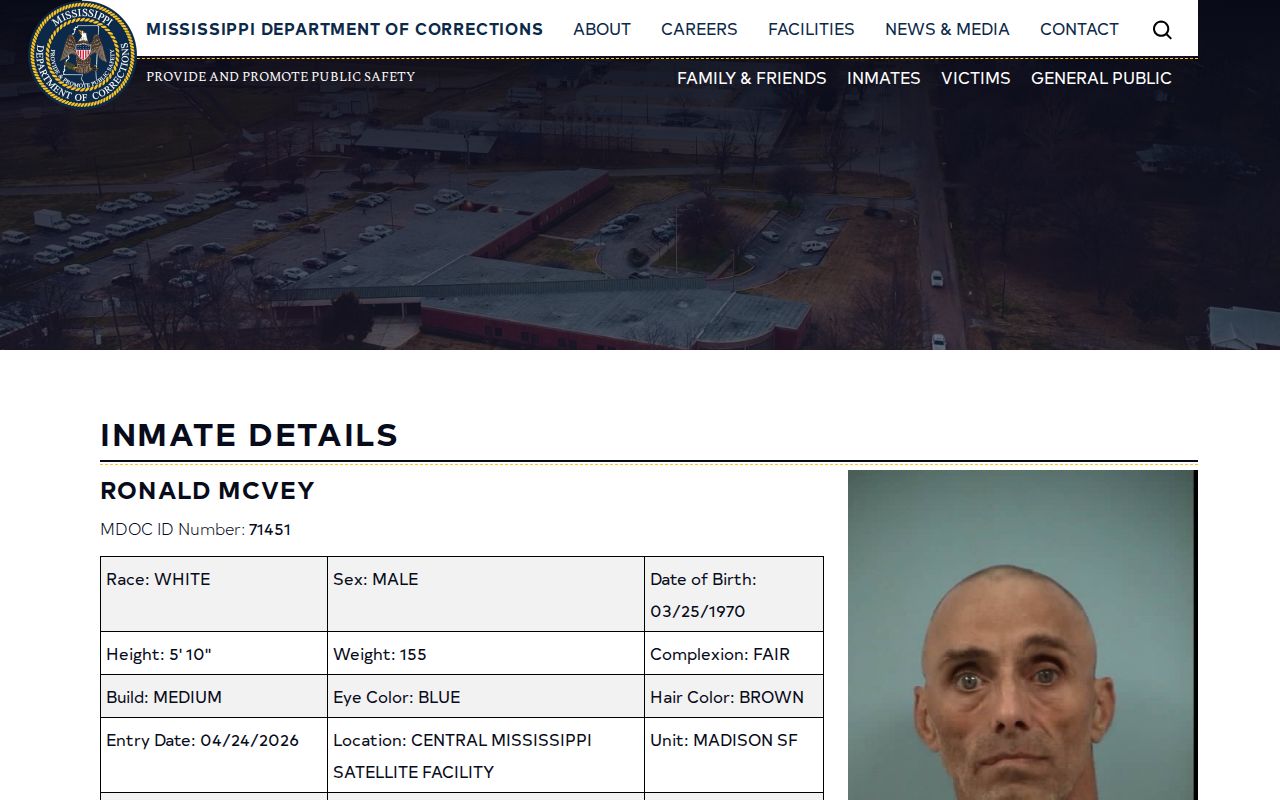
The captured page demonstrates the label and layout. A current live record and MDOC time sheet remain necessary for a person-specific date.
Note: If the detail still names a prison, do not describe the person as released solely because a tentative date has passed.
Marshall County Earned-Time Rules
A Marshall County court sentence is the starting point, not the final arithmetic. For sentences imposed after June 30, 1995, Miss. Code §47-5-138(5) states that an eligible inmate may receive four and one-half days of earned time for each 30 days served for compliant conduct and performance. The general cap is 15 percent of the sentence. That is the source of the shorthand that some covered Marshall County sentences result in service of about 85 percent.
The shorthand is not a universal Marshall County calculator. Miss. Code §47-5-139 and other statutes exclude categories. Offense type, sentence date, and later amendments matter. Credits are conditional and may be forfeited. Other lawful credit programs have different rules. Marshall County parole is separate because the State Parole Board makes a discretionary decision after eligibility is calculated. Subtracting 15 percent from every sentence can yield a false date.
The official MDOC copy of §47-5-138 explains earned time and earned release supervision. ERS can allow an eligible person to leave confinement before sentence expiration while remaining under MDOC jurisdiction as the statute provides. Maximum discharge is different. It marks a later sentence endpoint rather than a supervised release milestone.
Eligible presentence county-jail credit can affect the sentence-begin date. The MDOC handbook says the credit must relate to the cause for which the person is now incarcerated, and MDOC obtains the information from the conviction county. Concurrent terms run at the same time to the extent ordered. Consecutive terms run one after another. Several judgments can therefore make simple arithmetic based on one offense misleading.
Why Marshall County Release Dates Change
A Marshall County tentative date can move because MDOC is applying a live sentence record, not copying one number from the judgment. Some changes are legal, such as an amended order. Others arise from earned-time status, a detainer, or proof of Marshall County jail credit. A detainer is a request or hold from another authority that may affect what happens when the current custody term ends.
| Factor | Possible effect | Record to check |
|---|---|---|
| Earned time or forfeiture | Credits may shorten the term, while lawful loss can move the date later | MDOC time sheet and disciplinary credit record |
| County-jail credit | Eligible presentence time can change the sentence-begin date | Sheriff certification, booking/release record, and judgment |
| Concurrent or consecutive terms | Multiple sentences overlap or run in sequence as ordered | Each certified judgment and MDOC computation |
| Detainer or hold | Departure may become transfer to another custodian | MDOC movement history and holding agency record |
| Later court order | An amended, corrected, or revoked sentence changes the inputs | Court docket and signed order |
| Parole action | Eligibility or a grant may create another possible release path | Board action sheet and MDOC release record |
| Release plan review | Operational approval can affect physical departure timing | MDOC case-management and discharge record |
A date change does not by itself show an error. Compare the records first. Parole eligibility means the Board may consider release. A grant still can precede address approval, detainer review, and final processing. The Tentative Release Date remains adjustable. Maximum release or discharge carries a different legal meaning.
Correct Marshall County Time Credit
A person-specific discrepancy should go to MDOC Records with a focused document packet. Gather the certified judgment, commitment order, case number, MDOC ID, and the sheriff's jail certification or booking-and-release record. Mark the exact period that appears missing. Ask for the MDOC time sheet and a written resolution. This gives Records a concrete issue to trace rather than a broad claim that the public date looks wrong.
The MDOC Inmate Handbook explains that eligible pretrial or presentence credit is used to establish the sentence-begin date. The county of conviction supplies that data. If Marshall County custody is at issue, request the jail-docket dates from the sheriff and match them to the same cause and case number. Time held on a different matter may not apply to the MDOC term being reviewed.
Formal MDOC public-record requests are written and are not accepted by telephone. Use the MDOC Records Department contact path for the time sheet, release or movement history, and discharge certificate. A phone explanation can help route the inquiry, but it is not the written record. Keep copies of what was submitted and the response.
Note: Do not publish a homemade date calculator; a person-specific result depends on records and statutes that can change.
Marshall County Release Planning Process
The public Tentative Release Date is not a pickup appointment. MDOC's release-process information says the process can take 30 to 45 days and requires a discharge certificate before release. A case manager notifies the incarcerated person of the actual date and asks for travel plans. Those plans are checked as part of case management.
If bus travel is requested, MDOC says it may buy travel to the destination or the nearest city within Mississippi. It does not buy out-of-state bus travel. This is an MDOC statewide practice for the prison-release path, not a promise about people leaving Marshall County Jail. No matching sheriff-jail transportation policy was found.
This operational layer explains why a calendar estimate and departure can differ without implying that either record was fabricated. Residence approval, a detainer, travel verification, and the discharge certificate can all matter after the sentence math looks settled. Ask the case manager or Records Department what public milestone has been reached. Do not assume that a parole date, ERS date, tentative date, or planned trip proves release occurred.
Confirm Marshall County Actual Release
Confirmation comes from the agency that completed the custody event. For Marshall County Jail, obtain the sheriff's jail-docket entry showing release date, time, type or authority, and receiving agency. Pair it with the court order when bond, dismissal, time served, or a local sentence is involved. For an MDOC prisoner, read the current location and movement record, then request the discharge certificate or release history when the public detail is unclear.
Mississippi SAVIN and VINELink can provide prospective alerts for MDOC offenders and participating county jails. Marshall County Jail participation was not confirmed by an official list, so search for coverage instead of assuming it. The separate VINELink inmate check explains how to register for a custody-change notice. An alert is timely corroboration, but the named source agency remains the final authority.
Record the exact label and date shown. Then record the agency response and the actual release entry when it becomes available. This preserves the difference between what was projected and what happened. If the event says transfer, continue with the receiving agency rather than describing unrestricted community release.