
Reading Marshall County Release Status
Release is an event, not a full account of a person's legal status. Someone may leave the Marshall County Jail on bond, after a dismissal, with credit for time served, at the end of a local sentence, or under another court order. A person may instead leave that building in the custody of the Mississippi Department of Corrections, another county, the U.S. Marshals Service, or immigration authorities. Only the first set plainly describes a return to the community. The jail docket, release entry, and court order must be read together before calling a departure a release.
The agency holding the lasting record changes with the route. Sheriff Kenny Dickerson is identified by the official county sheriff page as county jailor, and the office keeps the jail docket. MDOC maintains prison movement, tentative-date, supervision, and discharge records. The court keeps the legal order behind bond, dismissal, sentence completion, probation, or revocation. A live custody roster, when one exists, answers who is held now. It does not preserve the full history of Marshall County released inmates after their names leave the current list.
Marshall County Release Types
The meaning of a Marshall County release depends on the authority and the next destination. Internal jail codes should not be guessed. Ask the record custodian to define each code and identify any receiving agency. That detail separates a community release from a transfer that continues custody.
| Release type | What it means | Best next record |
|---|---|---|
| Bond or recognizance | County custody ends while the case usually continues. | Jail release entry and court bond order |
| Time served or sentence complete | The person receives credit or reaches the end of the term being served. | Release entry, judgment, and sentence |
| Dismissal or acquittal | The case disposition may support release, unless another hold remains. | Filed court disposition and jail entry |
| Parole or earned release supervision | Prison confinement ends, but MDOC supervision and jurisdiction may continue. | MDOC record, Board action, and supervision record |
| Probation | A court directs community supervision, often instead of prison confinement. | Judgment and Community Corrections record |
| Agency transfer | Custody continues with MDOC, another jail, USMS, or ICE. | Movement entry and receiving-agency record |
A deceased status also ends custody, but it is not a community release and calls for careful, authoritative confirmation. A booking photo proves only that an image was created during a booking or corrections process. It does not prove guilt, release, or present custody. Each source answers a narrow question.
Marshall County Release Record Fields
A useful Marshall County release record ties one identified booking to the precise end of local custody. A request should seek fields, not a vague summary. This reduces the chance that a transfer code will be mistaken for unrestricted release and gives the sheriff enough detail to locate the right entry.
| Field | What it shows |
|---|---|
| Name and identifiers | Which person the booking concerns; date of birth can help distinguish similar names. |
| Booking number | The link between arrest, jail movement, release, and any booking photograph. |
| Booking date and time | When the period of Marshall County jail custody began. |
| Arresting or committing agency | Which office delivered the person or supplied the authority to hold. |
| Charges, court, and bond | The case track and any bond information retained as public record. |
| Release date and time | When sheriff custody ended for that booking. |
| Release authority or code | The stated reason for departure; request the agency's definition. |
| Receiving agency | Whether the person transferred to MDOC, another county, USMS, ICE, or another custodian. |
Mississippi state-prison records use a different set of terms. An MDOC detail can show location, entry and location-change dates, sentence blocks, county of conviction, and a field labeled “Tentative Release Date.” A deeper record may include parole eligibility, earned release supervision, jail credit, detainers, forfeitures, and a discharge certificate. None should be silently translated into a county-jail release code.
Request Marshall County Release Records
No verified online Marshall County release form, fee schedule, response time, office hours, or public roster was found. Mississippi's Public Records Act provides the general access framework, while the sheriff remains the first local custodian for the jail docket. A narrow written request is safer than assuming an unsupported fee or asking for every record about a person.
- Identify the full name, approximate booking date, and date of birth or booking number if legitimately known.
- Ask for the booking-to-release jail-docket entry for a stated date range, including the exact fields listed above.
- Request the release-code definition and any receiving-agency name. Specify an electronic copy and ask for an estimate before copies are made.
- Send the request to the Marshall County Sheriff's Office, P.O. Box 5100, Holly Springs, MS 38635, or call 662-252-1311 to confirm the proper delivery method.
- If the record points to a court or MDOC, request that agency's order, movement history, time sheet, or discharge record separately.
No jail-specific retention period was verified. If an entry or photo cannot be found, ask which retention authority applies and whether another system holds it. A 2018 request-produced roster shows that dated jail material has been released before, but it does not establish the current format, fee, storage period, address for a visit, or online access.
Note: Record the office, date, time, and exact question asked by phone, then seek a written entry when durable proof matters.
Request the Marshall Jail Docket
The phrase “jail docket” is locally important. The county sheriff page expressly says the sheriff keeps it, so a request for the jail-docket entry is more precise than a generic request for an inmate report. Ask for the entry that spans booking through departure, the release time and type, the authority, and the destination or receiving agency. The wording helps staff locate the event that a current-custody list no longer displays.
For durable confirmation, ask for a system-generated or signed copy when one is available. If staff say the person was “released to MDOC,” the docket has answered the county question but not the state one. Continue with MDOC. If the record says bond, recognizance, dismissal, time served, or sentence complete, pair it with the originating court order and check for any other hold before describing a return to the community.
Marshall County Release Record Law
Mississippi Code sections 25-61-1 through 25-61-19 govern public-record access in general. The law does not make every fact in every file automatically available. Juvenile information, sealed material, and other protected records require separate treatment. An agency may also need time to locate records or identify exempt parts. The Secretary of State law portal is a useful place to verify current code text.
Expungement is a court process that may change public access to qualifying records. Mississippi Code section 99-19-71 is one relevant provision, but eligibility and effect depend on the disposition and current law. A sealed or expunged case should be checked with the court that entered the order. The sheriff's release entry and the court docket serve different functions, and an older online trace should not override a current court response.
Marshall County Court Release Trail
Marshall County's court structure explains why the first release order and the lasting case result may sit in different offices. The county courts page says Justice Court handles felony initial appearances and holds jail sessions three times each week to support an initial appearance within three days. Circuit Court has original criminal jurisdiction over felony cases. A bond event may therefore begin on the Justice Court track while the durable felony disposition later appears in Circuit Court.
Ask the Marshall County Circuit Clerk for the actual filed order, not just a docket label. A bond order shows authority to leave the jail while a case remains open. A dismissal, nolle prosequi, or acquittal records the result. A judgment and sentence explain time served, probation, or commitment to MDOC. A revocation order can explain a later return. Mississippi Electronic Courts provides electronic case infrastructure, but public document access varies by court and account. The operational hour of release still belongs in the jail or MDOC record.
Find Marshall County Released Inmates
Start with the last known custodian. A person booked only into the Marshall County Jail follows the sheriff-and-court path. A person serving a state sentence follows MDOC. Federal and immigration custody use separate systems. Switching tracks as soon as a transfer appears is faster and more accurate than repeatedly searching a local current-inmate list.
- Confirm whether the last known custody was county, state, federal, or immigration custody.
- For the county jail, call the sheriff and request the jail-docket release entry, including the release code and receiving agency.
- Read the court disposition or release order to learn the legal reason that custody changed.
- If MDOC is named, search by MDOC ID or exact name and compare identifiers, location, sentence, and Tentative Release Date.
- Check parole records and Community Corrections when the state record points to supervision.
- Use VINELink for a participating-agency check or future notice, then verify an alert with the source agency.
- Use BOP or ICE only when the facts point to those systems, and file a narrow records request when online tools do not settle the question.
The Marshall County 24-Hour Release List explains the exact same-day request route because no verified rolling local feed exists. For one named person, a jail record plus the relevant legal or receiving-agency record gives the strongest confirmation.
Search MDOC Marshall County Releases
The MDOC Inmate Search accepts a name or MDOC ID. Use the ID when possible, then compare the record's identifiers before relying on a match. Results identify an ID number, name, location, term, offense, and a link to more detail. The detail format can include a photograph, entry date, present location and unit, location-change date, sentence blocks, county of conviction, and Tentative Release Date.
| Search or detail field | How to use it |
|---|---|
| First and last name | Start with exact spelling, then try a reasonable name variant. |
| MDOC ID | Best key for distinguishing people and making records or parole inquiries. |
| Location and change date | Distinguishes continued prison custody or transfer from a community status. |
| Sentence and county | Connects the state record to the correct judgment. |
| Tentative Release Date | A projected MDOC field that may change; it is not proof that release occurred. |
The official interface can be reviewed through the linked MDOC search. The capture below shows the Marshall County state-search path without turning a private person's record into editorial content.
View the official MDOC offender-search form before comparing a name or MDOC number.
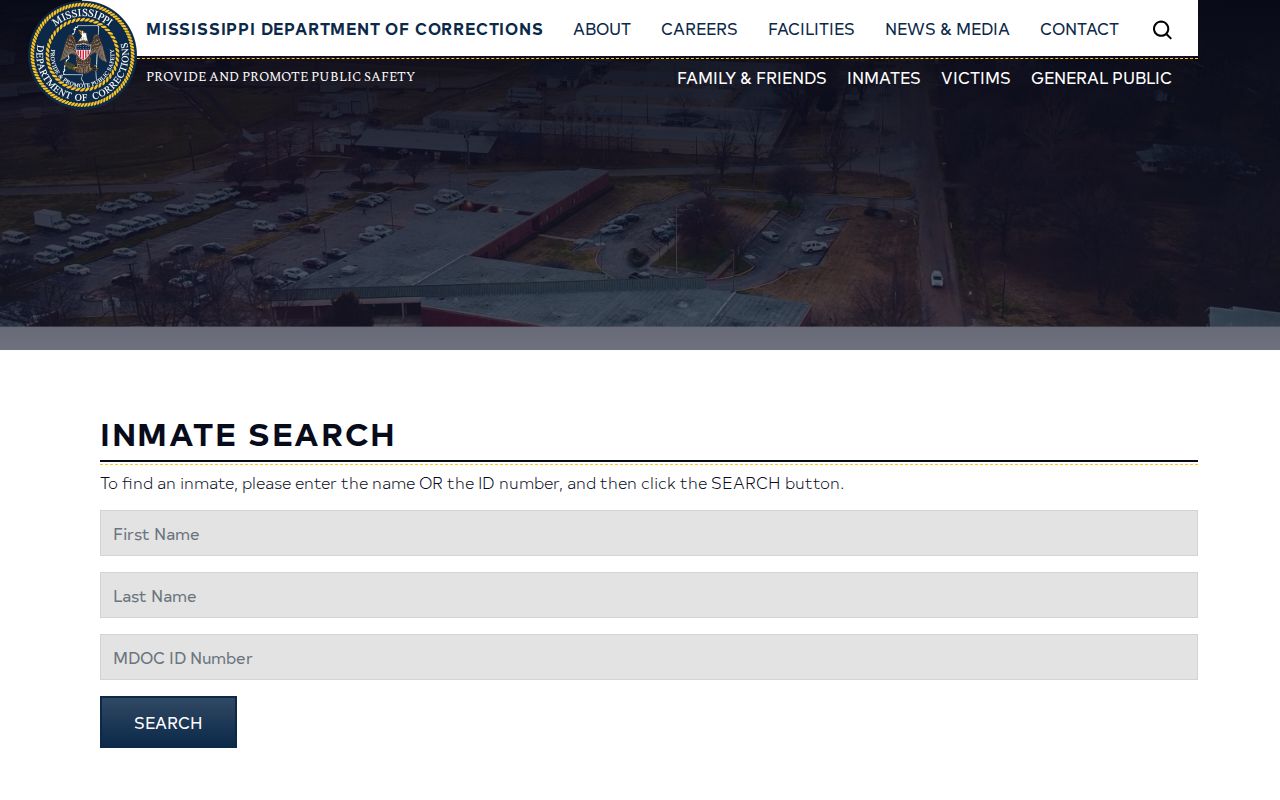
The form is statewide. It covers MDOC commitments and people held at Marshall County Correctional Facility, not ordinary county-jail bookings that never entered state custody.
Marshall County Recent Release Records
The Mississippi Marshall County sheriff does not publish a verified current roster, released view, 24-hour list, 72-hour list, archive, mobile app, update cadence, or online retention statement. Search results often surface an identically named Alabama sheriff with a polished released-inmate roster. It is the wrong jurisdiction. Confirm Mississippi, Holly Springs, and the 662 telephone area code before relying on any result.
A same-day or three-day inquiry should name a closed interval and time zone. Ask for release date and time, booking number, release code and its definition, court or charge, bond information if public, and transfer destination. If staff can only supply a current list, explain that the question concerns who left during the interval. Ask whether the jail system can export a release log. A historical request-produced roster supports the request path, but cannot prove present status or a current publishing schedule.
Verify Marshall County Release Supervision
Mississippi splits release decisions from supervision. The State Parole Board grants, denies, or revokes parole. MDOC Division of Community Corrections supervises parole, probation, earned release supervision, house arrest, and related statuses. Probation generally comes from a court. Parole follows a discretionary Board decision after prison. Earned release supervision is a statutory MDOC mechanism. None means the sentence or conviction has vanished.
Use the MDOC Parolee Search by name, MDOC ID, city, or county. A match supports a released-to-parole status, but it does not show that the whole sentence ended. The Marshall Probation and Parole Office can help identify the supervising unit where disclosure is allowed. A parole hearing, eligibility date, Board grant, operational release, and supervision start are separate milestones. The Marshall County parole and probation page covers that local verification handoff.
Marshall County Release Alerts
Mississippi SAVIN uses VINELink for custody information and notifications from MDOC and participating county jails. No official participation list was found that confirms the Marshall County Jail feed, so search for current coverage instead of assuming it. Open a reasonably matched record, select the offered notification option, choose an available channel, and retain the confirmation. When an alert arrives, call the named source agency for the authoritative time, type, and transfer destination.
VINE is designed for events and future alerts, not as a guaranteed long-term release archive. A transfer may generate an event that sounds like release from one facility while custody continues elsewhere. If Marshall County does not appear or a name is missing, return to the sheriff's jail docket. The state service also does not replace BOP or ICE tools.
Federal and Immigration Release Paths
Use the Federal Bureau of Prisons locator for a federal sentence. Its result can show a register number, age, race, sex, release date, and a location or status such as not in BOP custody. That status means BOP does not currently hold the person. It does not rule out another agency or federal supervision. A federal court judgment supplies the legal context.
When a Marshall County jail record names ICE, use the ICE Online Detainee Locator with the live form's A-number or biographical options. A missing result does not prove freedom. Recent movement and other limits can affect the result. A USMS transfer is also continued custody, but the Marshals Service has no general public name locator comparable to BOP. No operating federal or ICE detention facility was established in Marshall County.
Compare Marshall County Custody Records
Each source has a different job. The strongest result pairs the operational record showing where custody went with the legal record explaining why. Absence from one system should trigger a change of channel, not a conclusion.
| System | Best use | What it cannot prove alone |
|---|---|---|
| Sheriff jail docket | Actual end of Marshall County jail custody, release code, or transfer | The full court outcome or later status in another agency |
| Court record | Bond, dismissal, judgment, sentence, probation, or revocation authority | The hour staff completed release |
| MDOC search | State location, sentences, tentative date, and community context | An ordinary local booking that never entered MDOC |
| VINELink | Participating-agency status and future event alerts | A permanent historical or court record |
| BOP or ICE | Federal-sentence or immigration custody track | Unrestricted community release from all systems |
- Discharge
- The end of the corrections authority described by the issuing record, distinct from supervised release.
- Detainer
- A request or legal basis for another authority to take or continue custody.
- Time served
- Credit or completed custody that satisfies the term stated in the judgment.
- Transfer
- Movement to another facility or agency while custody continues.
Marshall County Release Facility Routes
Marshall County has two verified adult detention facilities, and their release records are not interchangeable. The Marshall County Jail is the sheriff's local facility. Community release may follow bond, dismissal, time served, a local sentence, or a court order, while some people transfer to MDOC or another authority. The jail docket and originating court are the core sources.
- Marshall County Jail: request the sheriff's booking-to-release docket entry and verify the court order or receiving agency.
- Marshall County Correctional Facility: use the statewide MDOC offender, discharge, parole, and Community Corrections records.
Marshall County Correctional Facility is a state prison, not an alternate name for the sheriff's jail. A person leaving its building may have transferred to another MDOC unit. A new institution or location-change date points to continued incarceration, while parole or earned release supervision indicates a community status under MDOC jurisdiction. No separate federal prison, ICE center, or verified Holly Springs municipal jail was found in the county.
Marshall Prison Release Record History
The MDOC facility record says Marshall County Correctional Facility opened in 1996 and changed from Management & Training Corporation operation to direct MDOC control on September 13, 2021. That shift matters when tracing the provenance of older records. A pre-transition entry may have begun in a contractor-maintained system even though MDOC is now the public custodian for current release, movement, time-computation, and discharge inquiries.
The change also helps prevent a common local error. The prison and sheriff's jail are separate institutions with different operators, populations, contacts, and search routes. Direct present requests to MDOC unless the agency identifies another custodian for a specific historical item.
Travel After Marshall County Release
MDOC release planning includes a practical travel step. The department says a case manager asks for travel plans and verifies them before state-prison release. If bus travel is requested, MDOC may buy a ticket to the destination or nearest city, but not for out-of-state travel. That policy belongs only to the MDOC path, including release from Marshall County Correctional Facility. No matching sheriff-jail transportation policy was verified.
MDOC also says the state release process can take 30 to 45 days and requires a discharge certificate. Those facts explain why a public Tentative Release Date is not a pickup appointment. The person in custody receives the operational date from the case manager after required checks. Family or friends should not apply the state travel policy to a county bond-out or assume the sheriff will provide the same service.